
Delivery partner (digital): Inclusive Bytes CIC (Oldham)
Partners: Full Circle NW CIC · First Choice Homes Oldham · Ridge · Vibe Immersive · Inclusive Bytes
Location: Nelson Way Community Centre, Chadderton, Oldham, OL9 8NL
Participants: Girls aged 12–18
Delivered: July 2026
Status: Completed
Summary
Summary
Girls: Designing Our Spaces put girls aged 12 to 18 in charge of assessing and redesigning the public spaces they actually use in Chadderton. The programme paired lived experience with digital tools (mapping, drones, ground robotics, digital design, digital twinning, and model-making) so the girls didn’t just say what was wrong with their area, they evidenced it and proposed changes.
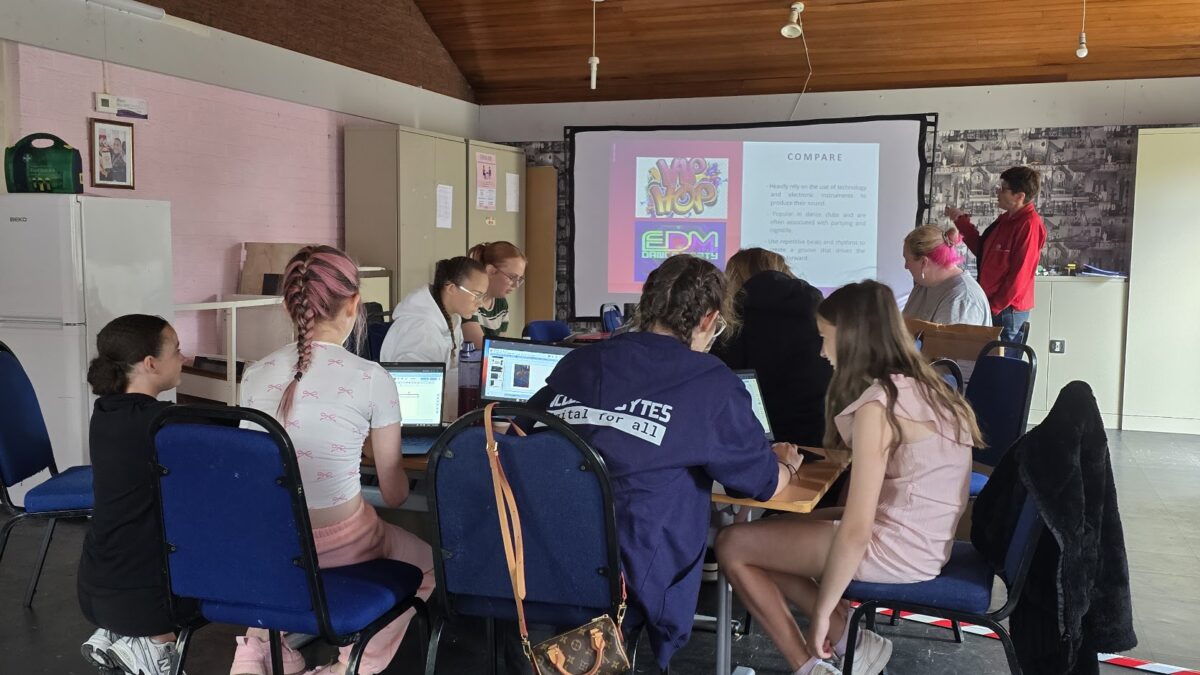
Inclusive Bytes delivered the digital and technical strand, including a purpose-built web app that let the girls mark up a map of their area, drawing and adding notes in teams to flag where they felt safe and unsafe. Overlaying the teams’ maps revealed where their judgements agreed; the group then visited those correlation hotspots in the park in person to see what was driving them. Built-environment partners brought the professional lens: Ridge showed the girls what surveyors do and guided them through the park as a surveyor would, and Vibe Immersive introduced the technology behind digital twinning. The work was grounded in a premise the group researched themselves: visible neglect (broken fences, poor lighting, overgrown trees, litter) signals a space isn’t cared for, which drives further decline. Fix the signals, and the space gets safer, brighter, and more used.


Who it was for
Girls aged 12 to 18 in Chadderton and the surrounding Oldham area: a group routinely under-consulted in placemaking and one that experiences public space differently, with safety, lighting, and “somewhere to be” coming up repeatedly in their own words. The programme was deliberately girls-only to make that voice the starting point rather than an afterthought.
What the girls did
Mapped safety in teams using a purpose-built web app. Inclusive Bytes built a web app that let the girls, working in teams, mark up a map of their area, drawing directly on it and adding notes to flag where they felt safe and unsafe, using a four-point key: Unsafe, Safe, Depends, Change. Sites covered included Coalshaw Green Road, Copster Hill, Freehold, Hollinwood, and the local park.
Overlaid the maps and ground-truthed the hotspots. The teams’ maps were overlaid to find where their judgements correlated, the places multiple teams independently flagged the same way. The group then visited those correlation points in the park in person, turning crowd-sourced data into a physical investigation of what was actually causing the problem. This was reinforced with a large hand-drawn version of the safety map as a shareable output.
Worked alongside surveyors. Ridge and partners explained what surveyors do and walked the girls through the park with a professional eye: how a built-environment specialist reads a space, assesses it, and turns observation into a case for change.
Were introduced to digital twinning. Vibe Immersive showed the girls the technology used to build digital twins, virtual data-driven replicas of real places, connecting the drone and mapping work to how spaces are actually modelled and planned in industry.
Documented specific problems in their own words, including: overgrown trees that cut out light and made the park feel unsafe; a broken fence; poor lighting; no toilets and no café; “nothing for older kids”; drug use; and the need for a second park entrance to avoid trouble at the tram stop.
Researched the numbers behind the problems to back up their case: figures the group surfaced themselves on CCTV coverage, street lighting cost and count across Oldham, and public spend on anti-social behaviour. (These are the group’s own research figures, worth a quick verification pass before any go into external reporting or funding bids.)
Used digital and technical tools delivered by Inclusive Bytes:
- Drones: aerial views of the sites they were assessing, giving them a planner’s-eye perspective on their own neighbourhood and feeding the digital-twinning work.
- Ground robotics: a camera rover driven around the space.
- Digital design and research on Inclusive Bytes Chromebooks.
- Model-making (LEGO): building physical models of redesigned spaces.
- Presenting: girls presenting their findings and ideas to the group.
Produced their own outputs, including hand-drawn area safety maps, a park audit illustration, and a project poster, turning observation into shareable evidence.
Presented their findings to the council. The programme finished with the girls presenting their evidence and design proposals directly to the local council, putting their own research, in their own words, in front of the people who can act on it. This was the point of the whole process: not a workshop that ended in the room, but girls’ voices reaching a decision-making table.
Method
Straightforward and repeatable:
Inputs → girls’ lived experience + a purpose-built mapping web app + Inclusive Bytes kit (drones, robotics, Chromebooks) + surveying and digital-twinning expertise (Ridge, Vibe Immersive) + a host venue + partner support (Full Circle, First Choice Homes).
Process → mark up safety maps in teams (web app) → overlay maps to find correlation → ground-truth the hotspots in the park → learn how surveyors read a space → document problems → research the evidence → visualise from above (drone) and up close (robot) → understand digital twinning → design and model solutions → present findings to the council.
Outputs → a mapped safety audit, a costed/evidenced list of issues, girl-led design proposals, and a group of young women who used real technical and professional tools and stood up to present.
Aims
- Give girls a genuine, evidenced voice in how their local spaces are designed.
- Build digital and technical skills (mapping, drone/robot operation, digital twinning, design, presenting) through a project that mattered to them.
- Expose the girls to real built-environment careers, surveying and immersive tech, through direct contact with professionals.
- Produce credible, girl-led evidence that partners and the local authority can act on.
Impact and outcomes
- A cohort of girls aged 12 to 18 completed the programme in Chadderton.
- The group produced a team-mapped, overlaid safety audit (via a purpose-built Inclusive Bytes web app), a park audit, a costed/evidenced problem list, design proposals, and a project poster.
- Correlation hotspots identified in the app were ground-truthed on site in the park.
- The girls presented their findings and proposals directly to the local council: the programme’s finale, putting their evidence in front of decision-makers.
- Girls worked directly with surveyors (Ridge) and were introduced to digital-twinning technology (Vibe Immersive): real exposure to built-environment and immersive-tech careers.
- Hands-on use of drones, ground robotics, digital design, and model-making.
(Add the cohort size, any participant quotes, and any partner/council commitments the evidence has prompted, for impact and funding reporting.)
Why it worked
It handed girls real tools and a real question about their own area, so the skills stuck because the subject was theirs. Bringing in surveyors and digital-twinning specialists turned it from a youth activity into a genuine brush with how places get assessed and built. The audit-to-design method turned a feeling (“I don’t feel safe here”) into evidence a partner can act on, and it ended with the girls putting that evidence directly to the council, not just to each other. The structure is replicable across other wards and cohorts, making it a model First Choice Homes, Full Circle, and the council can extend rather than a one-off safety maps, a park audit illustration, and a project poster, turning observation into shareable evidence.


