Ten or fifteen years ago, a batch of rickshaws were shipped into Oldham for a race. Most of them scattered afterwards. One of them ended up with Oldham Theatre Workshop, where it sat and served its time.
When OTW moved to a new home, the rickshaw didn’t fit the plan. No storage, no obvious use, and the usual fate for something like that is a skip. Instead they asked us if we wanted it.
We’re Inclusive Bytes, a community tech outfit in Oldham. Reusing kit that other people have written off, and putting young people’s hands on it, is more or less the whole job. So this was squarely our kind of problem.
We did. But not to store it in a corner and forget about it, that’s just deferring the skip. So we asked the more useful question: what could this actually become?
The answer was a mobile karaoke booth.
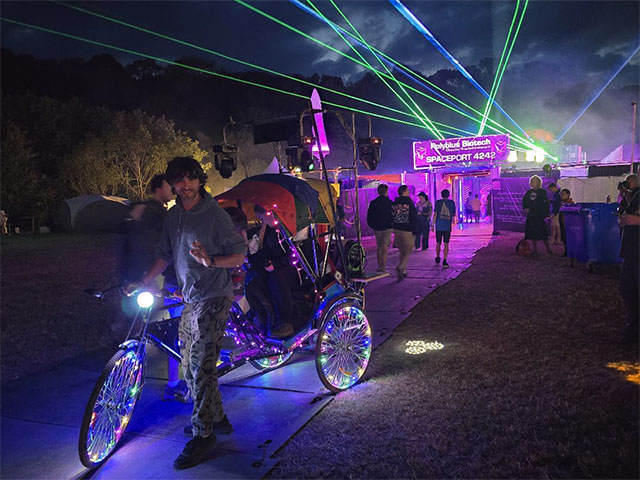
We rebuilt it as a moving stage. Sound system, a wrap of lights across the frame and through the wheels, the whole thing wired to run off its own power and put on a show after dark. A rickshaw that used to be about getting from A to B became a reason to stop and gather.
The build was the point
The finished rickshaw is the fun bit. The build is where the actual work happened.
Getting it from cast-off to working stage meant young people picking up tools, most for the first time. Spanners. Drills. A soldering iron. How to change a tyre and not be frightened of it. None of that was taught as a lesson, it was taught because the job in front of them needed doing, which is the only way any of it ever really sticks.
That’s the model we keep coming back to: don’t run a workshop about a skill, hand someone a real thing that has to work by the weekend and let the skill be the thing standing between them and finishing it.
EMF Camp
This weekend we took it to EMF Camp, a field full of makers, hackers and engineers, which is exactly the right crowd for a rewired rickshaw. The deal was simple: we’d carry you across the site, and the fare was a song.
It worked better than a fare in cash ever would. People sang, other people followed the noise, and a piece of kit that was one decision away from being scrapped spent the weekend lit up under the lasers doing the one thing nobody imported it to do.
Something to talk about
There’s a second payoff that’s easy to miss.
Sooner or later every young person gets asked the question, in an interview, on a course, on an application: tell us about a project you’ve worked on. Most of them reach for the same tired answer. A group presentation. A poster. Something they half-remember and nobody in the room wants to hear about.
The ones who built this have a different answer now. I helped rewire a rickshaw into a karaoke stage and took it to a hacker camp where we ferried people around a field in exchange for a song. That’s not a line you forget, and it’s not a line the person opposite forgets either. It shows initiative, hands-on skill and the ability to see something odd through to the end, all the things a presentation is supposed to prove and never does.
Confidence isn’t taught in a session. It’s what’s left over after you’ve built something real and watched it work in front of a crowd.
Why we bother
Most useful things don’t die because they’re broken, they die because nobody has the space, the time, or the imagination to give them a second job. The same is true of a skill, and arguably of a young person’s sense of what they’re capable of.
A racing rickshaw became a theatre prop, became a skip candidate, became a karaoke stage in a field full of hackers. Along the way it taught a group of young people how to use their hands and handed them a story worth telling.
Nothing was wasted. It just kept finding new reasons to exist.